Accreditation Programmes are formal mechanisms through which healthcare organisations are independently assessed for compliance with defined quality and patient safety standards. These programmes involve a rigorous evaluation of clinical processes, governance systems, infrastructure, and service delivery practices. Accreditation signifies that an institution consistently follows evidence-based protocols, prioritises patient well-being, and fosters a culture of continuous improvement. It enhances institutional credibility, builds public trust, and positions the organisation as a leader in quality healthcare.
With an objective to provide access to quality health care for the majority of citizens especially those residing in villages, small towns, NABL launched voluntary programme namely “NABL Medical (Entry Level) Testing Labs {NABL M(EL)T Labs} Recognition Program” for the medical testing laboratories performing basic testing
To ensure the quality and competency of the temporary site testing laboratories, NABL has launched a recognition scheme for such laboratories.
To ensure the quality of soil for the majority of citizens especially those residing in villages, small towns, NABL has launched a quality assurance scheme to sensitize the Soil Testing Laboratories performing basic testing.
These Recognition schemes are independent quality assurance schemes, which are not covered under APAC & ILAC* MRA.
*A new, single international accreditation organisation, Global Accreditation Cooperation Incorporated, has been established on 1 January 2026 to bring together the work of the International Laboratory Accreditation Cooperation (ILAC) and the International Accreditation Forum (IAF). Click Here for further details
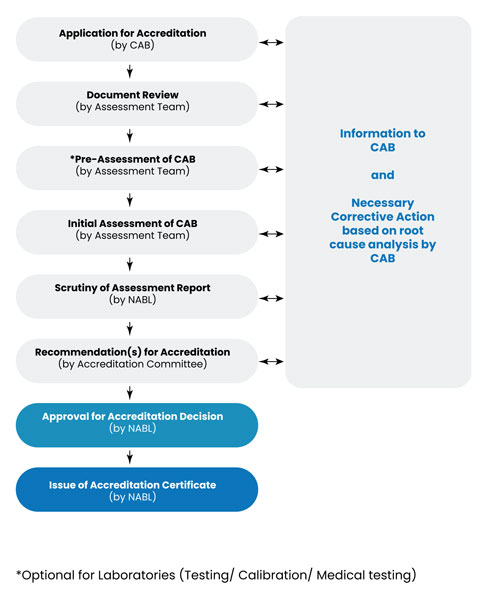
 Recognized Process