
Recognition Scheme >
Soil Testing Laboratory Program
Overview
NABL has launched scheme to sensitize the Soil Testing Laboratories performing basic testing to ensure the quality of soil for the majority of citizens especially those residing in villages, small towns.
This scheme is an independent quality assurance scheme, which is not covered under APAC & ILAC MRA
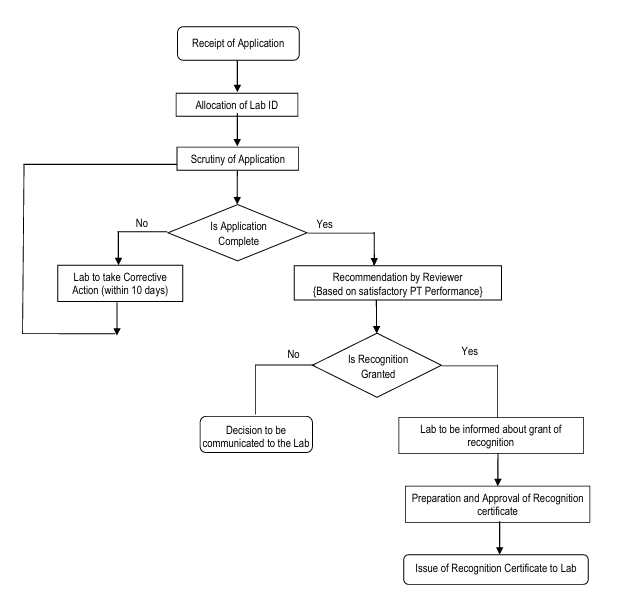
This scheme is based on satisfactory proficiency testing (PT) performance and valid for a cycle of three years, which will further be continued on renewal basis after every three years.
Laboratory application will be reviewed by NABL and decision on recognition will be taken based on performance in proficiency testing (PT). During the recognition period (within three years), on-site assessment (surveillance) may be conducted.
Benefits of Recognition
Eligibility
The laboratory shall be legally identified as a Government Soil testing laboratory under the Department of Agriculture & Co-operation under the Ministry of Agriculture and Farmers’ Welfare. The laboratory has to submit a self-declaration from the Head of the Department as evidence of its status as a Soil testing laboratory operating under the Department of Agriculture, Government of India. Type of Legal entity Document(s) to be submitted Government Gazette or Government Notification or selfDeclaration on Letter head by Head of the organization
The applicant laboratory shall have satisfactorily participated in Proficiency Testing (PT) program conducted by accredited PT provider as per ISO/IEC 17043 before submission of application
Fee Structure
| Components | Fee/Charges |
|---|---|
| Recognition Fees (for three years, to be submitted along with application) | ₹ 15000 /- |
| Surveillance Charge (payable at the time On actual of surveillance) | On actual basis |
| Renewal Fees (for three years, to be submitted along with renewal application) | ₹ 15000 /- | For details on other applicable fees, kindly refer NABL 100A. |
Scope of Scheme
| S. No. | Discipline – Group – Sub Group | Test Parameter | Range | Test Method(s) | CRM / RM |
|---|---|---|---|---|---|
| 1 | CHEMICAL – Soil & Rock – Agriculture Soil | pH | 1 to 14 | Manual of Soil Testing (Soil Water Suspension) | pH Buffers |
| 2 | CHEMICAL – Soil & Rock – Agriculture Soil | pH | 1 to 14 | Manual of Soil Testing (Woodruff’s Method) | pH Buffers |
| 3 | CHEMICAL – Soil & Rock – Agriculture Soil | pH | 1 to 14 | Manual of Soil Testing (Shoe Maker Method) | pH Buffers |
| 4 | CHEMICAL – Soil & Rock – Agriculture Soil | pH | 1 to 14 | IS 2720 (Part 26) | pH Buffers |
| 5 | CHEMICAL – Soil & Rock – Agriculture Soil | Electrical Conductivity | 0.1dS/m to 10 dS/m | Manual of Soil Testing | |
| 6 | CHEMICAL – Soil & Rock – Agriculture Soil | Electrical Conductivity | 0.1dS/m to 10 dS/m | IS 14767 | |
| 7 | CHEMICAL – Soil & Rock – Agriculture Soil | Organic Carbon | 0.1% to 5% | Manual of Soil Testing (Loss of Weight on Ignition) | |
| 8 | CHEMICAL – Soil & Rock – Agriculture Soil | Organic Carbon | 0.1% to 5% | Manual of Soil Testing (Walkley and Black, 1934) (Volumetric Method) | |
| 9 | CHEMICAL – Soil & Rock – Agriculture Soil | Organic Carbon | 0.1% to 5% | Manual of Soil Testing (Colorimetric Method) | |
| 10 | CHEMICAL – Soil & Rock – Agriculture Soil | Available Nitrogen | 0.1kg/ha to 1000 kg/ha | Manual of Soil Testing (Subbiah and Asija, 1956) | |
| 11 | CHEMICAL – Soil & Rock – Agriculture Soil | Available Phosphorus | 0.1kg/ha to 300 kg/ha | Manual of Soil Testing (Olsen et al., 1954) | Phosphorus Standard |
| 12 | CHEMICAL – Soil & Rock – Agriculture Soil | Available Phosphorus | 0.1kg/ha to 300 kg/ha | Manual of Soil Testing (Bray and Kurtz, 1945) | Phosphorus Standard |
| 13 | CHEMICAL – Soil & Rock – Agriculture Soil | Available Phosphorus | 0.1kg/ha to 300 kg/ha | Manual of Soil Testing(ICP) | Phosphorus Standard |
| 14 | CHEMICAL – Soil & Rock – Agriculture Soil | Available Potassium | 0.1kg/ha to 1000 kg/ha | Manual of Soil Testing (Toth and Prince, 1949) | Potassium Standard |
| 15 | CHEMICAL – Soil & Rock – Agriculture Soil | Available Potassium | 0.1kg/ha to 1000 kg/ha | Manual of Soil Testing (ICP) | Potassium Standard |
| 16 | CHEMICAL – Soil & Rock – Agriculture Soil | Available Sulphur | 0.1mg/kg to 200 mg/Kg | Manual of Soil Testing (Chesnin and Yien, 1950) | Sulphur Standard |
| 17 | CHEMICAL – Soil & Rock – Agriculture Soil | Available Sulphur | 0.1mg/kg to 200 mg/Kg | Manual of Soil Testing (ICP) | Sulphur Standard |
| 18 | CHEMICAL – Soil & Rock – Agriculture Soil | Zinc | 0.1mg/kg to 20 mg/kg | Manual of Soil Testing (Lindsay and Norvell, 1956) (AAS) | Zinc Standard |
| 19 | CHEMICAL – Soil & Rock – Agriculture Soil | Zinc | 0.1mg/kg to 20 mg/kg | Manual of Soil Testing (Lindsay and Norvell, 1956) (ICP) | Zinc Standard |
| 20 | CHEMICAL – Soil & Rock – Agriculture Soil | Iron | 0.1mg/kg to 20 mg/kg | Manual of Soil Testing (Lindsay and Norvell, 1956) (AAS) | Iron Standard |
| 21 | CHEMICAL – Soil & Rock – Agriculture Soil | Iron | 0.1mg/kg to 20 mg/kg | Manual of Soil Testing (Lindsay and Norvell, 1956) (ICP) | Iron Standard |
| 22 | CHEMICAL – Soil & Rock – Agriculture Soil | Copper | 0.1mg/kg to 20 mg/kg | Manual of Soil Testing (Lindsay and Norvell, 1956) (AAS) | Copper Standard |
| 23 | CHEMICAL – Soil & Rock – Agriculture Soil | Copper | 0.1mg/kg to 20 mg/kg | Manual of Soil Testing (Lindsay and Norvell, 1956) (ICP) | Copper Standard |
| 24 | CHEMICAL – Soil & Rock – Agriculture Soil | Manganese | 0.1mg/kg to 20 mg/kg | Manual of Soil Testing (Lindsay and Norvell, 1956) (AAS) | Manganese Standard |
| 25 | CHEMICAL – Soil & Rock – Agriculture Soil | Manganese | 0.1mg/kg to 20 mg/kg | Manual of Soil Testing (Lindsay and Norvell, 1956) (ICP) | Manganese Standard |
| 26 | CHEMICAL – Soil & Rock – Agriculture Soil | Boron | 0.1mg/kg to 20 mg/kg | Manual of Soil Testing (Lindsay and Norvell, 1956) (AAS) | Boron Standard |
| 27 | CHEMICAL – Soil & Rock – Agriculture Soil | Boron | 0.1mg/kg to 20 mg/kg | Manual of Soil Testing (Lindsay and Norvell, 1956) (ICP) | Boron Standard |
Equipment
| S. No. | Discipline | Equipment Name | In-house/ traceability | External/ laboratory name |
|---|---|---|---|---|
| 1 | Chemical | pH Meter | Traceable to SI units using CRM | NA |
| 2 | Chemical | measuring cyliner | NA | NABL Accredited Calibration Lab |
| 3 | Chemical | Beaker | NABL Accredited Calibration Lab | |
| 4 | Chemical | Weighting Balance | NA | NABL Accredited Calibration Lab |
| 5 | Chemical | Sieve Stainless Steel | NA | NABL Accredited Calibration Lab |
| 6 | Chemical | Automatic Pipettes | NA | NABL Accredited Calibration Lab |
| 7 | Chemical | Volumetric Flask | NA | NABL Accredited Calibration Lab |
| 8 | Chemical | Mortar With Rubber Covered Pestle | NA | NA |
| 9 | Chemical | Pipettes | NA | NABL Accredited Calibration Lab |
| 10 | Chemical | Elecctrical Conductity Meter | Traceable to SI units using CRM | Manufacturer Certificate |
| 11 | Chemical | Shaking Machine | NA | NA |
| 12 | Chemical | Thermometer | NA | NABL Accredited Calibration Lab |
| 13 | Chemical | Oven | NA | NABL Accredited Calibration Lab |
| 14 | Chemical | erlenmeyer flasks | NA | NABL Accredited Calibration Lab |
| 15 | Chemical | Muffle Furnance | NA | NABL Accredited Calibration Lab |
| 16 | Chemical | Digital Burette | NA | NABL Accredited Calibration Lab |
| 17 | Chemical | Conical Flask | NA | NABL Accredited Calibration Lab |
| 18 | Chemical | Atomic Absorption Spectrophotometer | NA | NABL Accredited Calibration Lab |
| 19 | Chemical | Kjeldahl digestion and distillation unit | NA | NABL Accredited Calibration Lab |
| 20 | Chemical | measuring cyliner | NA | NABL Accredited Calibration Lab |
| 21 | Chemical | heater | NA | NABL Accredited Calibration Lab |
| 22 | Chemical | Bottel Top Dispenser | NA | NABL Accredited Calibration Lab |
| 23 | Chemical | Inductively Coupled Plasma meter | Traceable to SI units using CRM | |
| 24 | Chemical | Flame Photometer | Traceable to SI units using CRM |
Refrence Material
| S. No. | Discipline | Reference Material | Traceability |
|---|---|---|---|
| 1 | Chemical | Boron Standard | Traceable to SI Units |
| 2 | Chemical | Calcium Chloride | Traceable to SI Units |
| 3 | Chemical | Copper Standard | Traceable to SI Units |
| 4 | Chemical | Iron Standard | Traceable to SI Units |
| 5 | Chemical | Manganese Standard | Traceable to SI Units |
| 6 | Chemical | pH Buffers | Traceable to SI Units |
| 7 | Chemical | Phosphorus Standard | Traceable to SI Units |
| 8 | Chemical | Potassium Standard | Traceable to SI Units |
| 9 | Chemical | Stannous chloride | Traceable to SI Units |
| 10 | Chemical | Sulphur Standard | Traceable to SI Units |
| 11 | Chemical | Zinc Standard | Traceable to SI Units |
Remarks
For laboratories going for recognition can also use PUSA STFR Meter to determine the above 12 parameters including available nitrogen calculated from organic carbon content of soil and use of CRMs as mentioned and calibrated equipment’s subject o success participation in PT
Relevant Documents
| Document No. | Document Title | View Document |
|---|---|---|
| NABL 226 | Specific Criteria to Recognise Government Soil Testing Laboratory | View / Download |
Support
Contact Us
- anita@nabl.qcin.org, neeraj@nabl.qcin.org
- 0124 – 4679700 / 701
Legal Disclaimer
NABL has tried to thoroughly verify all information available on this site for its correctness and would try to continuously update the information on a regular basis. However, NABL does not make any claim that the information made available, is fully correct and can be used for purposes other than elementary reference. NABL does not make any claim that information derived from the Laboratory Search Option is complete and accurate. This information is indicative and is meant to be a quick guide for locating laboratories for testing and calibration. The schedules for training and awareness programmes are subject to change. Correct schedules may be checked out with the NABL office. Links to third party Web sites on this Site are provided solely as a convenience to the visitor. NABL has not reviewed all of these third party sites and does not control and is not responsible for any of these sites or their content. Thus NABL does not endorse or make any representations about these sites. The visitor to this site would hold NABL indemnified against any loss, damage, penalties or liabilities incurred by visiting or deriving information from this site, or using the information for any and all commercial and non-commercial purposes.