
Publications and Resources >
FAQs
What are the aims and objectives of NABL?
Where is the NABL office located?
NABL Secretariat functions from its office at J200, World Trade Centre, Nauroji Nagar, New Delhi, 110029. It administers and coordinates all NABL activities, including accreditation for Testing, Calibration and Medical Llaboratories, Proficiency Testing Providers, Reference Material Producers and Biobanks.
What are the office timings of NABL?
NABL’s working days are Monday to Friday, with office timings from 9:00 a.m. to 5:30 p.m.
What is accreditation?
- Laboratory accreditation formally recognizes technical competence for specific tests/measurements based on third-party assessment following international standards.
- Similarly, PTP accreditation recognizes competence in providing proficiency testing,
- RMP accreditation recognizes competence in producing reference materials, and
- Biobank recognizes that biological materials and their associated data collections maintain appropriate quality for their intended use.
What are the benefits of accreditation?
- International recognition/equivalence
- Access to global market
- Time and money efficient
- Enhanced customer confidence and satisfaction
- Robust Quality Management System
- Continual improvements
- Better operational control
- Assurance of accurate and reliable results
- Cost reduction
- Prevent loss due to defects
- Accreditation provides a ready means for customers to identify and select reliable testing, measurement and calibration services that meet their needs.
- Increased confidence in Testing/Calibration Reports emphasizing accuracy and reliable results.
- Results from accredited laboratories are used by regulators for public benefit (unpolluted environment, safe food, clean water, energy, health and social care).
- Better control of laboratory operations and feedback on Quality Assurance and technical competence.
- Helpful for participating in tenders requiring independently verified laboratories.
- Greater access to domestic and international markets for users of accredited laboratories.
- Potential increase in business due to enhanced customer confidence; helps reduce re-testing costs for exporters.
- Savings in time and money due to reduced or eliminated re-testing.
- Enables comparison of a laboratory’s data with others and independent appraisal against reference values or peer performance.
- Comparison of a facility’s performance with peer facilities.
- Monitoring of long-term performance of a facility.
- Improvement in test/calibration performance following investigation of unsatisfactory PT results and corrective action.
- Staff education, training and competence monitoring.
- Evaluation of methods, including precision and accuracy.
- Contribution to the laboratory’s overall risk management system.
- Confidence building with customers, accreditation bodies, regulators and specifiers.
- Confidence in measurements through traceability to appropriate measurement standards using certified reference materials (CRMs).
- Assurance that accredited RMPs are competent to produce RMs listed in their scope, per internationally recognized principles.
- CRMs offer an effective means to assess trueness and precision of a measurement process.
- RMs help demonstrate that a measurement process is in statistical control.
- Accreditation determines RMP technical competence and helps users identify suitable RMs.
- Accreditation is an effective marketing tool for RMPs.
- Confidence to RM users that RMs/CRMs are fit for intended uses.
- Supports precision/trueness assessment, quality control, value assignment, calibration and conventional scales.
- Uniform global approach (ISO 17034:2016) enables mutual arrangements between accreditation bodies across economies.
How is NABL accreditation different from ISO 9000 certification?
ISO 9000 certification covers only the Quality System Management, while NABL accreditation provides formal recognition of the technical competence of CABs in addition to the quality system.
Accreditation is a higher-level activity than system certification; it requires technical experts to assess a CAB against internationally accepted criteria such as ISO/IEC 17025 (Testing & Calibration), ISO 15189 (Medical), ISO/IEC 17043 (PTP) and ISO 17034 (RMP).
Accreditation against these standards also covers the quality management system elements of ISO 9000, making NABL accreditation a measure of both technical competence and quality management.
Can we take help from an external person/organization (e.g. Advisor, Consultant) for preparation of NABL accreditation?
What types of CABs can seek accreditation?
- CABs undertaking testing (including Medical), calibration, Proficiency Testing and Reference Material Production in specified fields.
- Private or government CABs.
- Small operations to large multi-field CABs.
- Site facilities and mobile laboratories.
Which fields of CABs are covered by NABL?
| Testing Laboratories | Calibration Laboratories | Medical Laboratories |
|---|---|---|
| Biological | Electro-Technical | Clinical Biochemistry |
| Chemical | Mechanical | Clinical Pathology |
| Electrical | Fluid Flow | Haematology & Immunohaematology |
| Electronics | Thermal | Microbiology & Infectious Disease Serology |
| Fluid-Flow | Radiological | Histopathology |
| Mechanical | Optical | Cytopathology |
| Non-Destructive Testing | Medical Devices | CytoGenetics |
| Photometry | Nuclear Medicine (in-vitro tests only) | |
| Radiological | Molecular Testing | |
| Diagnostic Radiology QA testing | Flow Cytometry | |
| Forensic | Medical Imaging – Conformity Assessment Bodies (MI-CAB) | |
| Software & IT System |
| Proficiency Testing Providers | Reference Material Producers |
|---|---|
| Testing | Chemical Composition |
| Calibration | Biological & Clinical Properties |
| Medical | Physical Properties |
| Inspection | Engineering Properties |
| Miscellaneous Properties |
| Bio Banks |
|---|
| Human |
| Veterinary |
| Plant Material |
| Microorganisms |
Why use an accredited CAB?
How would NABL accreditation help a CAB reach out to global customers?
NABL is a signatory to ILAC and APAC Mutual Recognition Arrangements (MRA), based on mutual evaluation and acceptance of other MRA partner accreditation systems. This facilitates acceptance of test/calibration results between MRA partner countries, reducing or eliminating the need for re-testing of exported goods in another country.
Note: A new, single international accreditation organisation, Global Accreditation Cooperation Incorporated, was established on 1 January 2026, bringing together the work of ILAC and the IAF.
Is accreditation a one-time phenomenon?
Is it mandatory for laboratories to participate in Proficiency Testing programs?
As per Clause 3.1, NABL 163, the applicant laboratory shall satisfactorily participate in at least one PT program/ EQA prior to gaining accreditation in each discipline applied. Accredited laboratory shall have 2-year plan for Proficiency Testing participation which shall cover all the accredited groups as practicable under each discipline of accreditation. In Medical testing, accredited laboratories shall participate in at least one Proficiency Testing/ EQA in a year per discipline, as appropriate.
Kindly refer NABL 163: Policy for participation in Proficiency Testing activities, available under Publications → NABL Documents on NABL website. The list of NABL accredited PTPs and available PT programs (by group/field, as per NABL 120) is also available on the website.
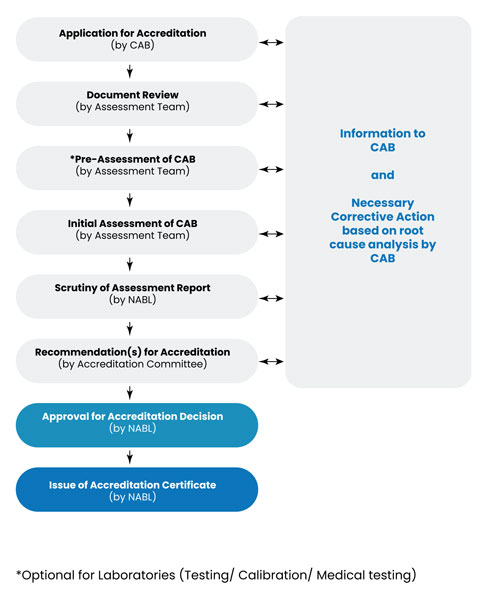
What is the process for accreditation at NABL?
- Application Submission: CAB submits the prescribed NABL application form(NABL 151 for testing, NABL 152 for calibration, NABL 153 for medical, NABL 180 for PTP, NABL 190 for RMP, NABL 154 for Integrated Assessment of Testing Laboratories, NABL 155 for Medical Entry Level Testing labs, and NABL 156 for Medical Imaging-CABs), along with the system document (e.g., quality manual) and the prescribed fee per NABL 100A.
- Application Review: NABL acknowledges the application, assigns a unique ID, and reviews it for completeness. Requesting clarifications if needed.
- Pre-Assessment (Optional): A pre-assessment may be conducted by a Lead Assessor to evaluate non-conformities, assess preparedness, and determine the number of assessors and locations needed. A pre-assessment report is submitted, and the CAB takes corrective action.
- Assessment: After satisfactory corrective action, NABL finalizes the assessment team (lead assessor and technical assessors/experts, possibly an observer), who review the management system and technical competence, report any non-conformities, and recommend for or against accreditation.
- Closure of Nonconformities: The CAB addresses identified nonconformities and submits corrective actions within the stipulated timeframe
- Accreditation Decision: NABL Secretariat reviews the assessment report the CAB must close non-conformities and submit a report within 30 days, the Accreditation Committee makes recommendations for accreditation.
- Grant of Accreditation: NABL issues the accreditation certificate and scope of accreditation.
- Appeal: All NABL decisions are open to appeal by the CAB, addressed to the CEO, NABL.
- Upon a positive recommendation, NABL issues an accreditation certificate with a unique number, NABL QR code, discipline, validity date and scope of accreditation.
- For site laboratories, site-performed tests/calibrations are clearly identified in the scope.
- The applicant CAB must complete all payments due before certificates are issued.
- Accredited CABs must conform at all times to the applicable standard (ISO/IEC 17025, ISO 15189, ISO/IEC 17043, ISO 17034 or ISO 20387) and relevant NABL policies, including NABL 131 (Terms & Conditions).
- The certificate is valid for 4 years, with annual surveillance to verify continued compliance.
- The accredited CAB undergoes re-assessment every 2 years and must apply well in advance of expiry to maintain continuity of accreditation.
How does NABL monitor the accredited CABs?
Who at NABL should a CAB contact before initiating the process of accreditation?
Enquiries for accreditation may be mailed to the Information Cell at info@nabl.qcin.org.
What are the preparations required by a CAB before applying for accreditation?
- Make a definite plan of action for obtaining accreditation and nominate a responsible coordinator familiar with the CAB’s existing quality system.
- Get fully acquainted with relevant NABL documents and understand the assessment procedure and application filing methodology.
- Have a Quality Manual satisfying the requirements of ISO/IEC 17025, ISO 15189, ISO/IEC 17043, ISO 17034 or ISO 20387 and relevant NABL specific criteria.
- Ensure the competence of the proposed Quality Manager will be adjudged during assessment.
- Ensure procedures in the Quality Manual and other documents are actually implemented; site testing/calibration must comply with NABL 130.
- Participate satisfactorily in a proficiency testing program (or inter-laboratory comparison if no suitable PT program exists) — minimum one parameter/test/calibration per discipline prior to accreditation, and ongoing per NABL 163.
- Conduct at least one internal audit and a management review before submitting the application.
Is there a publication that can guide me through the accreditation process?
What is Mutual Recognition Arrangement (MRA) with international bodies, and what are its benefits for NABL-accredited laboratories?
Many countries have accreditation bodies following ISO/IEC 17025 (Testing & Calibration), ISO 15189 (Medical), ISO/IEC 17043 (PTP), ISO 17034 (RMP) and ISO 20387 (Biobank). This uniform approach allows accreditation bodies to establish arrangements through APAC and EA peer evaluation, based on mutual evaluation and acceptance of each other’s systems. MRAs enable test data to be accepted between countries, reducing costs and the need for re-testing. NABL is a signatory to ILAC(renamed as Global ACI*) and APAC MRAs for Testing (including Medical), Calibration laboratories, PTP and RMP.
Note: A new, single international accreditation organisation, Global Accreditation Cooperation Incorporated, was established on 1 January 2026, bringing together the work of ILAC and the IAF.
How can we know of the Proficiency Testing programmes?
What training courses are offered by NABL?
NABL Technical trainings: With an objective to disseminate knowledge and strengthen the technical competence of the personnel involved in accreditation and quality-related activities, NABL, QCI has launched the technical trainings on various standards and applicable accreditation requirements. The details of these technical trainings are posted on NABL website.
Please note that these technical trainings courses confine themselves to providing generic information, freely available in the public domain, i.e. they don’t provide specific solutions to a CAB.
Assessor Training: NABL organizes training courses only to train its Assessors; this is not an open course. Selection of experts for assessor training is done by NABL based on current/anticipated requirements and availability of already trained assessors. Applications can be made via the NABL website under Training → Assessors Training Course → Introduction.
How to use the NABL symbol?
Refer to document NABL 133 – ‘Policy for Use of NABL Symbol and/or Claim of Accreditation by Accredited Conformity Assessment Bodies (CAB) & NABL Accredited CAB Combined ILAC* MRA Mark’.
Note: A new, single international accreditation organisation, Global Accreditation Cooperation Incorporated, was established on 1 January 2026, bringing together the work of ILAC and the IAF.
How does using an accredited CAB benefit Government and Regulators?
- Protecting health and welfare of consumers and the public at large.
- Protecting the environment.
- Developing new regulations and requirements.
- Measuring compliance with regulatory and legal requirements.
- Allocating resources, both technical and financial.
- Increasing confidence in data used to establish baselines for key analysis and decisions.
- Reducing uncertainties in decisions affecting protection of human health and the environment.
- Increasing public confidence, as accreditation is a recognizable mark of approval.
- Eliminating redundant reviews and improving assessment efficiency, potentially reducing costs.
How do I know a CAB is accredited by NABL?
Why is a CAB's technical competence so critical to a manufacturer, supplier, exporter or customer?
- Minimum risk.
- Avoid expensive re-testing.
- Enhance customer confidence.
- Reduce costs and improve acceptance of goods overseas.
How does NABL determine the number of assessors assigned to conduct a CAB's assessment?
What is peer evaluation?
How long does it take for a CAB to obtain NABL accreditation?
What is the "Scope of Accreditation"?
One Person Company (OPC)
NABL exercises due diligence to safeguard accredited CABs, encouraging business entities to adopt models where the liability of the legal entity is not linked to that of the person running the business.
What is the benefit of a One Person Company (OPC)?
An OPC combines features of a Company with the benefits of a Sole Proprietorship, with concessional/relaxed requirements under the Companies Act, 2013. The proprietor’s liability is limited, and the shareholder is not personally liable for the company’s debts.
How does OPC provide better credibility to a CAB?
OPC provides a standardized, accountable approach with corporate governance, separation of personal and business assets, and better compliance with legal and financial obligations, reinforcing trust in CAB services.
In what ways is OPC not related to its proprietor?
OPC has a separate legal status distinct from its owner and benefits from perpetual succession.
Limited Liability Partnership (LLP)
NABL exercises due diligence to safeguard accredited CABs, encouraging business entities to adopt models where the liability of the legal entity is not linked to that of the person running the business.
What is the benefit of a Limited Liability Partnership (LLP)?
An LLP is a separate legal entity liable to the full extent of its assets, while partners’ liability is limited to their agreed contribution. The LLP continues regardless of changes in partners, and no partner is liable for another partner’s independent or unauthorized actions.
How does LLP provide better credibility to a CAB?
LLP provides a standardized, accountable approach with corporate governance, separation of personal and business assets, and better compliance with legal and financial obligations, reinforcing trust in CAB services.
In what ways is LLP not related to its partners?
LLP is a separate legal entity from its partners and continues to exist despite changes in partners.
Clarification on the Role of NABL in Enforcing Regulations
Accreditation is the independent evaluation of conformity assessment bodies against recognized normative documents (standards, regulations, etc.) to ensure impartiality, consistency of operation and competence. Laboratories are accredited to applicable international standards — ISO/IEC 17025 for testing and calibration, and ISO 15189 for medical laboratories. Results from accredited laboratories are used extensively by regulators for public benefit (environment, food safety, water, energy, health and social care).
NABL is a voluntary accreditation body and has no regulatory powers; checking compliance with regulatory requirements falls under the purview of the respective applicable regulator. It remains the responsibility of each laboratory to abide by all applicable National and State statutory requirements, Acts, Ordinances, Rules, Regulations, Legal Orders and Court Decisions/Orders as issued and in force from time to time.