Accreditation >

Accreditation Explained

Why NABL

Accreditation is a third-party attestation related to a conformity assessment body, conveying formal demonstration of its competence to carry out specific conformity assessment activities. A Conformity Assessment Body (CAB) is an organization that performs conformity assessment activities, including testing laboratories (including medical laboratories), calibration laboratories, proficiency testing providers, certified reference material producers, and biobanks.

The liberalization of trade and industry policies of the Government of India has created quality consciousness in domestic trade and provided greater thrust for export. As a consequence testing centres and laboratories have to demonstrably operate at an internationally acceptable level of competence.

Laboratory accreditation is a procedure by which an authoritative body gives formal recognition of technical competence for specific tests/ measurements, based on third party assessment and following international standards.

Similarly, Proficiency testing Provider accreditation gives formal recognition of competence for organizations that provide proficiency testing. Reference Material Producers Accreditation gives formal recognition of competence to carry out the production of reference materials based on third party assessment and following international standards.

Benefits of Laboratory Accreditation

Formal recognition of competence of a laboratory by NABL in accordance with international criteria has many advantages:

International recognition

Access to Global market

Time and money efficient

Enhanced customer confidence and satisfaction

Robust Quality Management System

Continual improvements

Better operational control

Assurance of accurate and reliable results

Prevent loss due to defects

Benefits of Laboratory Accreditation

Benefits of Accreditation for Proficiency Testing Providers

Benefits of Accreditation for Reference Materials Producers

Scroll to Top
Benefits of Laboratory Accreditation
Formal recognition of competence of a laboratory by NABL in accordance with international criteria has many advantages:
  • A ready means for customers to identify and select reliable testing, measurement and calibration services that are able to meet their needs.
  • Increased confidence in Testing/ Calibration Reports issued by the testing, calibration and medical testing laboratories which emphasise on accuracy and reliable results.
  • The results from accredited laboratories are used extensively by regulators for the public benefit in the provision of services that promote an unpolluted environment, safe food, clean water, energy, health and social care services.
  • Better control of laboratory operations and feedback to laboratories as to whether they have sound Quality Assurance System and are technically competent.
  • Helpful in participating in tenders that require independently verified laboratories.
  • Potential increase in business due to enhanced customer confidence and satisfaction
  • Users of accredited laboratories enjoy greater access for their products, in both domestic and international markets.
  • Savings in terms of time and money due to reduction or elimination of the need for re-testing of products.
Benefits of Accreditation for Proficiency Testing Providers

The benefits of proficiency testing are widely recognized. These include:

  • Many laboratories operate in isolation from other laboratories and do not have ongoing opportunities to compare their data with others. Without such opportunities there are risks that the data of a laboratory may have errors, biases or significant differences when compared to data from other similar laboratories. Proficiency testing provides an opportunity to undertake such comparisons and to have an independent appraisal of the laboratory’s data compared to reference values (or other performance criteria) or to the performance of similar laboratories. The results from such participation provide laboratory managers with either a confirmation that the laboratory’s performance is satisfactory or an alert that an investigation of potential problems within the laboratory is required.
  • Comparison of the performance of a facility’s performance with that of other participating (peer) facilities
  • Monitoring of the long-term performance of a facility.
  • Improvement in the performance of tests/calibrations following investigation and identification of the cause(s) of unsatisfactory PT performance, and the introduction of corrective action to prevent re-occurrence
  • Staff education, training and competence monitoring
  • Evaluation of methods, including the establishment of method precision and accuracy
  • Contribution to the facility’s overall risk management system
  • Confidence building with interested parties, e.g. customers, accreditation bodies, regulators, specifiers.

Proficiency testing providers play an important role in the value chain for assurance of products and services. Being an NABL accredited PTP in accordance with ISO/IEC 17043 gives the organization credibility for their PT services.

Benefits of Accreditation for Reference Materials Producers
Formal recognition of competence of an RMP by NABL in accordance with international criteria (ISO 17034) has many advantages like:
  • Confidence in measurements by establishing traceability to appropriate measurement standards such as the use of certified reference materials (CRMs) produced by a competent producer to give a reliable physical or chemical characterization of a material.
  • It provides assurance that the accredited RMPs are competent to produce the RMs as listed in the scope of accreditation. It provides confidence to RM users that the reference materials (RMs), and certified reference materials (CRMs) in particular, are produced according to technically valid and internationally recognized principles, and fit for the intended uses.
  • CRMs offer a most effective means to assess the trueness and precision of a measurement process.
  • Reference materials (RMs) provide one of the most effective ways of assessing and demonstrating that the measurement process is in statistical control because the homogeneity and stability of RMs have been confirmed to be suitable for use as quality control materials.
  • Accreditation is a means of determining the technical competence of RMPs to produce specific RMs. It also provides formal recognition to competent RMPs, thus providing a ready means for RMs users to identify and select the most suitable RMs that meet their needs. This recognition of competence relates to the properties of the reference materials that the accredited RMP produces, and may include, if applicable, the ranges of the assigned values and their associated uncertainties. It may also include the RMPs involvement in the performance of testing, calibration and measurements in relation to homogeneity, stability and characterization assessments and their use of subcontractors in these tasks. These are the factors that RM users need to know and consider when selecting RMs
  • Accreditation is an effective marketing tool for RMPs
  • Accreditation provides assurance that the accredited RMPs are competent to produce the RMs as listed in the scope of accreditation
  • It provides confidence to RM users that the reference materials (RMs), and certified reference materials (CRMs) in particular, are produced according to technically valid and internationally recognized principles, and fit for the intended uses.
  • These uses include the assessment of precision and trueness of measurement methods, quality control, assigning values to materials, calibration, and the establishment of conventional scales. This eliminates the needs of the users to evaluate the quality of the RMs themselves
  • RMs are used globally. Many economies around the world have accreditation bodies offering accreditation to RMPs. These accreditation bodies have adopted ISO 17034: 2016 as the criteria for RMP accreditation. This has helped economies to adopt a uniform approach for determining RMP competence. This uniform approach allows accreditation bodies in different economies to establish arrangements among themselves, based on mutual evaluation and acceptance of each other’s RMP accreditation systems.
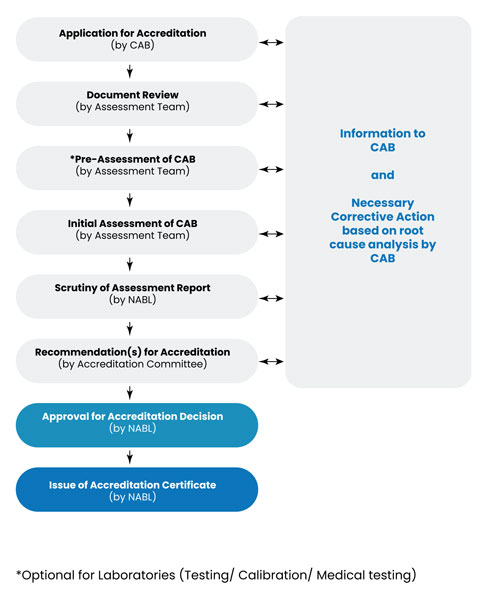
Accreditation Process
accreditation-process